

How to make a folded PDF booklet from ordinary pages
Turn PDF pages into an A4 landscape booklet with a visible sheet plan and blanks added only where needed.
Open PDF Fold Lab →Follow these steps
- Open one PDF and choose Folded booklet or Four cut-out cards.
- Enter optional source page ranges such as 1, 3-5. For a booklet, review the front/back sheet plan; zero positions are shown as blanks.
- Press Create print PDF and Download PDF. Print a test sheet at 100%; use landscape short-edge duplex for the booklet, then stack and fold.
Why pages look out of order on screen
A booklet places the first and last reading pages together on the outside of a sheet. The inner sheets continue that pattern. With six selected pages, the first sheet front is blank / 1 and its back is 2 / blank; the second sheet front is 6 / 3 and back is 4 / 5. After duplex printing, nesting and folding, the reading order becomes 1 through 6.
Test before printing everything
Print only the first front/back sheet at actual size. Use A4 landscape and short-edge flip, then fold it and check that the two sides are upright. Printer drivers can use different labels for duplex orientation. If the test is inverted, change the flip setting before printing the whole pack.
Keep your workflow focused
Upload only the documents required for this task. Files are processed in this browser, and the original documents are not overwritten. Download the result before closing the tab. These dedicated workspaces do not automatically import unsaved changes from another PDF Studio tool.
If a document is protected, use Remove password with a password you know before opening it here. Large or complex pages can require substantial memory. The workspace accepts PDFs under 50 MB each, at most 12 files, and bounded page counts; split an unusually large document first.
A checked example you can try
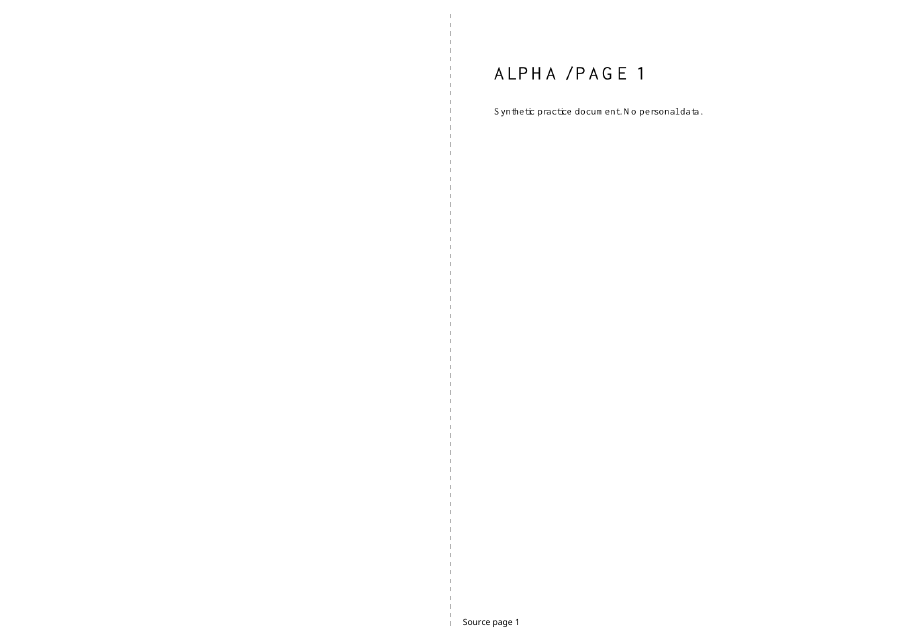
Six Alpha pages produced four landscape output pages, using two duplex sheets and two padded blanks. The printed fold itself needs your printer check.
Settings used in this engine check
- layout
- fold-lab
PDF Fold Lab, in four moments
Open your pages
Open one PDF and choose Folded booklet or Four cut-out cards.
An illustrated walkthrough, not a processing test. Reduced motion is on; choose each moment manually.
Check the result
Reopen the downloaded PDF. Check page count, readable content and front/back alignment on a test print.
Keep the original. When this task produces a file, reopen the download in the application where you will use it and inspect the affected pages. An illustration explains the operation; it is not a recorded processing test.
Practical tips
- Keep the originals and use a descriptive filename for the exported copy.
- Print only the first front/back sheet at actual size. Use A4 landscape and short-edge flip, then fold it and check that the two sides are upright. Printer drivers can use different labels for duplex orientation. If the test is inverted, change the flip setting before printing the whole pack.
Questions
Will my original files change?
No. Download a separate result. The source files remain unchanged.
Do the files leave my device?
No document upload is used. PDF processing runs in your browser.
What should I check before sharing?
Print layouts contain page images, so selectable text, links and form fields do not survive. A4 paper and a short-edge duplex test are required for the booklet. No printer setting is controlled automatically.